· News · 3 min read
The story behind the new zem.no
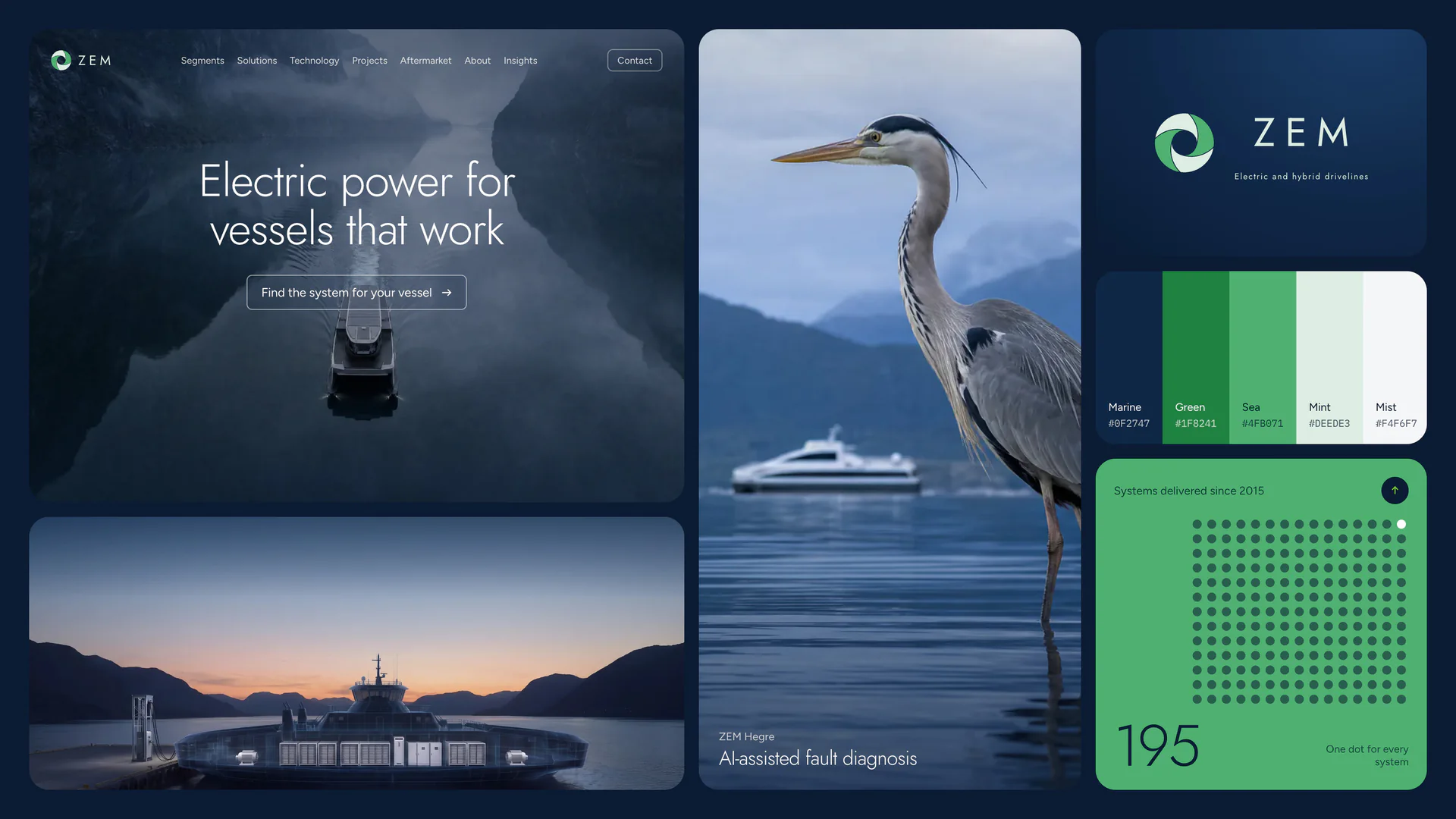
ZEM has a new website. It has a new look and a new feel, but it is the same ZEM, and it is built to develop with us in the years ahead.
Why a new website
ZEM has grown fast. Since 2015 we have delivered 195 battery and hybrid systems, to ferries, aquaculture workboats, crew transfer vessels, tugs and supply vessels. More and more people told us they wanted something fresher. The website we had no longer represented what we deliver, or where we are as a company.
A first draft over a weekend
We got in touch with Vegard at Ailo on a Friday. With very little input from us, he made a first draft over the weekend, with a direction and a design. It was not finished, but it hit the mark.
We invited Vegard in to explain his thinking. He was curious and wanted to know more: who we are, who our customers are, where they come from, and what they are looking for when they come to our website.
From a website to clearer products
After several reviews, with Vegard and within our own team, the work grew beyond the website. We started looking at what we actually deliver and sell, and how to package it so it is easier for our customers to choose.
The result is four system packages, ZEM Stormsvale, Havsule, Havhest and Havlire. Service agreements and ZEM Hegre, our AI-assisted fault diagnosis, follow each system after delivery.
Why birds
Packages need names. We went through fjords, mountains, sea areas and animals, but it was the birds of the coast that stuck. Like the systems we build, each of them is made for its own kind of work, and all of them use their energy and power wisely to keep going, far out at sea and in rough weather.
- ZEM Stormsvale, for compact vessels: Leach's storm petrel weighs just 40 to 50 grams and flies in quick, agile turns.
- ZEM Havsule, for heavy-duty vessels: the gannet is the largest seabird breeding in the North Atlantic, and dives at around 85 km/h.
- ZEM Havhest, for high-capacity vessels: the fulmar, a relative of the albatrosses, glides on stiff wings using the wind over the waves, and can live for more than 40 years.
- ZEM Havlire, for mobile energy and charging: the shearwater skims the wave tops, harvesting energy from the wind, all the way to its winter waters off Argentina.
- ZEM Hegre, our AI-assisted fault diagnosis: the grey heron can stand motionless at the water's edge for hours, and strike the instant something moves. Hegre does the same with a vessel's data.
To keep the Nordic roots we come from, we chose birds of the North Atlantic coast and kept their Norwegian names, on the English site too.
Distilled, round by round
Then came several rounds of content and distilling: what to say, what to leave out, and how to say it so that a shipowner, a yard or a designer quickly finds what they need. The site is now built around the questions our customers ask:
- What does your vessel do? Six segments, from offshore to yachts.
- Which system fits? Four packages, from compact vessels to mobile energy and charging.
- What happens after delivery? Service agreements, software upgrades and ZEM Hegre.
Built to develop with us
We are very proud of the result. The new zem.no shows where ZEM stands today, and it will develop with us as we deliver more systems, to larger vessels and in more markets.
A big thank you to Vegard and Ailo for a fantastic collaboration and follow-up all the way.
Picture: the new look of zem.no, with the home page, ZEM Hegre, the logo, the colours and one dot for every system delivered