· Insight · 3 min read
Hybrid workboat savings: the diesel ran just 6 % of the time
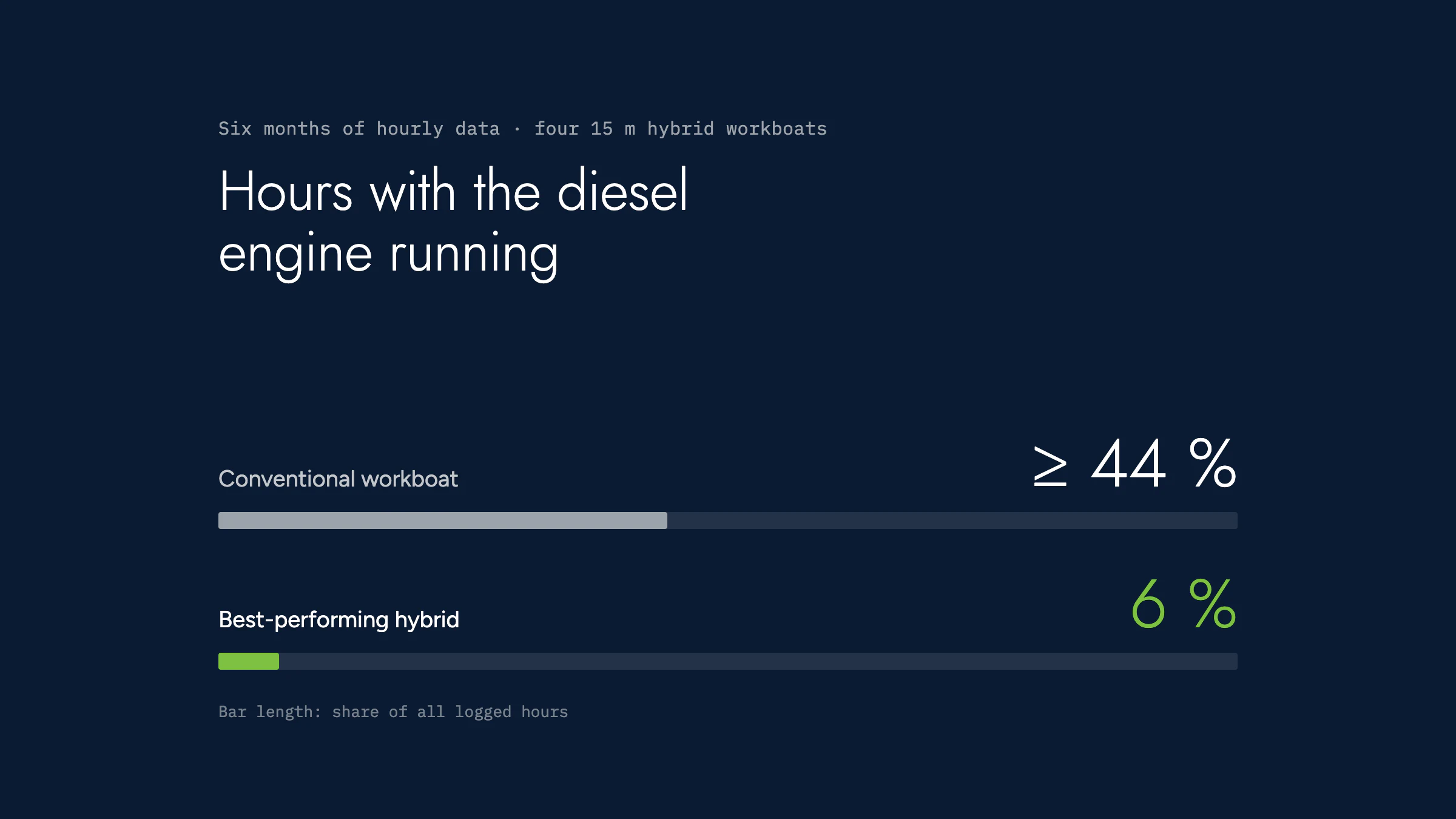
On the best of four hybrid aquaculture workboats in a six-month study, the diesel engine ran just 6 % of the time. On a conventional workboat, it ran at least 44 % of the time. Here is what the data shows, where the savings come from, and what it means if you are planning a hybrid workboat.
6 %
of the hours with the diesel running, best hybrid
≥ 44 %
of the hours on the conventional workboat
6,800–8,400 L
diesel replaced in six months, with shore power
NOK 0.65 M
net gain a year, about
ZEM's CEO Jonathan Sørbye presented the results at the Maritime Hybrid, Electric and Hydrogen Fuel Cells Community Conference in Bergen.
What was measured
The data comes from one Norwegian workboat operator in aquaculture: four 15-metre hybrid workboats and one conventional reference vessel, logged hour by hour for six months. The operator is not named.
Hourly logs show more than how much fuel each boat used. They show when the diesel ran, and what the boat was doing at the time.
Most of the day, a workboat is waiting
The boats spent 55–78 % of their hours alongside or idle. That is the key to the result. A conventional workboat keeps its diesel running through those hours, at low load, where a diesel engine runs least efficiently.
A hybrid workboat covers those hours from the battery. On the best-performing hybrid, 80 % of the working hours were fully electric. The diesel is only needed when the work calls for more power, or to charge the battery where there is no shore power.
Litres saved, and tonnes of CO₂
With shore power, the best hybrid replaced 6,800–8,400 litres of diesel in six months, and avoided 19–23 tonnes of CO₂. That is one 15-metre boat in half a year. An operator with several boats, over a full year, multiplies it.
Count engine hours, not just litres
Compared with a conventional vessel, the net gain is about NOK 0.65 million a year. Roughly half of it comes from fewer engine hours and less maintenance, not from fuel. Fewer running hours mean longer between services and overhauls, and in this data that was worth as much as the fuel.
Shore power is the biggest lever
Charging decides the payback. Without shore power, the payback time was around 14 years. With 50 % shore power, it dropped to around 8 years. The battery saves the most when it is charged from the grid at the base, not by the boat's own diesel.
That makes charging part of the vessel project, not something to solve afterwards. Where the grid at an aquaculture base is weak, a battery container such as ZEM Havlire can store energy and fast-charge the boats.
How ZEM builds a hybrid workboat
ZEM delivers the battery, inverters, transformer and control as one engineered package. On aquaculture workboats, the systems go up to 1,100 kWh, with twin electric propulsion from 2 × 100 kW to 2 × 900 kW. The crew can run on battery only, on genset and battery together, with load balancing, or in silent mode.
Three lessons for anyone planning a hybrid workboat
- Design to the logged duty cycle, not a design point. A boat that waits most of the day needs a different system from the one its peak load suggests.
- Count engine hours, not just litres. Maintenance and engine life are half of the business case.
- Plan charging together with the vessel. Shore power at the base is what turns a good hybrid into a short payback.
More than 100 workboats with Moen Marin
Together with Moen Marin, ZEM has delivered hybrid and fully electric systems for more than 100 aquaculture workboats and service catamarans since 2019. See aquaculture, or ZEM Havsule, the package for heavy-duty workboats.
Questions and answers
How much diesel does a hybrid workboat save?
In six months of hourly data, the best of four 15-metre hybrid workboats replaced 6,800–8,400 litres of diesel with shore power. Its diesel engine ran 6 % of the time, against at least 44 % on a conventional workboat.
What is the payback time for a hybrid workboat?
In this data, around 14 years without shore power, and around 8 years with 50 % shore power. Charging is the biggest lever.
Where do the savings come from?
About half from fuel, and about half from fewer engine hours and less maintenance. The net gain was about NOK 0.65 million a year compared with a conventional vessel.
Does a hybrid workboat need shore power?
No. It can charge the battery with its own diesel, but shore power is what makes the biggest difference to fuel, emissions and payback.
Planning a newbuild or a retrofit? Talk to our sales team.